







Inside Audi’s Formula 1 reset, from minimalist livery to long-term ambition
The German performance marque is taking a sharp turn
 By
By 
AS I’M WRITING THIS, I’m sitting in a Las Vegas hotel, overlooking the Formula 1 extravaganza that’s taken over the city for the 2025 Formula 1 Las Vegas Grand Prix. The vibe is peak hedonism, peak capitalism and peak maximalism – everything modern Formula 1 has become.
Just a week-and-a-half prior, Audi, which will be entering Formula 1 this year after acquiring the Sauber Group (the current Stake F1 team), dropped its new Formula 1 concept show car and livery. Daring and minimalist in its aesthetic, it pleasingly pushes against the high-energy, oversaturated mood of what I see before me here in Vegas. The move not only signals a brand intent on rewriting its motorsport narrative, but echoes the wider shift the German OEM is making towards more minimalist, clean and sublimely technical-looking design languages, as seen by its recent Audi Concept C. Audi is entering its most exciting era in years, including a full shakeup, and intends to use Formula 1 to stretch its wider perception from the race track to the road, as well as a platform for its future design identity.
At the helm of the Audi F1 Project is former Ferrari team principal and current COO and CTO for Sauber Motorsport, Mattia Binotto, and one of the most experienced men in F1 (and current Stake F1 team principal), Jonathan Wheatley. The driver lineup follows through from the current Stake F1 team, blending experience and potential: Germany’s Nico Hülkenberg, a seasoned, tenacious and much-loved talent, is paired with Brazilian rising star Gabriel Bortoleto, 2024’s F2 champion. Collectively, the entire team will have been tasked with turning a midfield outfit into a championship contender, a transformation that won’t come easy.
“This is the most exciting project in motorsports, if not in all sports,” says Binotto. “The goal is clear: to fight for championships by 2030. That journey takes time, the right people and a mindset of continuous improvement.” Adds Wheatley: “Our project is more than building a team. It is about shaping the future of F1 – with talent, visionary partners and the transformation of the Audi brand. We have a mindset that dares to redefine what a racing team can be.”
For Audo, motorsport is ingrained in its DNA. From the Auto Union Silver Arrows of the ’30s to Le Mans victories, touring car dominance, rallying triumphs, GT3 success, four seasons in Formula E and beyond, the company has consistently pursued innovation on the track. Formula 1 represents a new level of advancement, a chance to combine heritage with cutting-edge technology at the most elite level.
“Whenever Audi entered a racing series, success followed. Audi has never entered just to compete, but instead with the aim of leading, innovating and being victorious. That’s exactly what we are striving for in Formula 1,” says Audi CEO Gernot Döllner. “Our entry into Formula 1 is part of something bigger. It’s the next step in the company’s renewal, designed to strengthen our competitiveness on the global stage. In Formula 1, every second counts. Success demands performance, precision and teamwork.”
This year, Formula 1 will undergo major regulatory changes, presenting a unique opportunity for a full grid reset. The new mandates will call for slightly shorter, narrower and lighter cars, which feature marginally narrower tyres. The hybrid electric powertrain systems will switch to a 50/50 power split between the internal combustion engine and battery-electric system. We’ll say goodbye to DRS (Drag Reduction System) and hello to a manual override boost that can be used anywhere on the track for overtaking (under certain conditions), and it will all be powered by100 per cent sustainable fuel. For new entrants like Audi (which is making its own engines), Cadillac (with engines supplied by Honda) and Ford (powering Red Bull’s two teams), there’s never been a better nor more competitive time to enter F1.
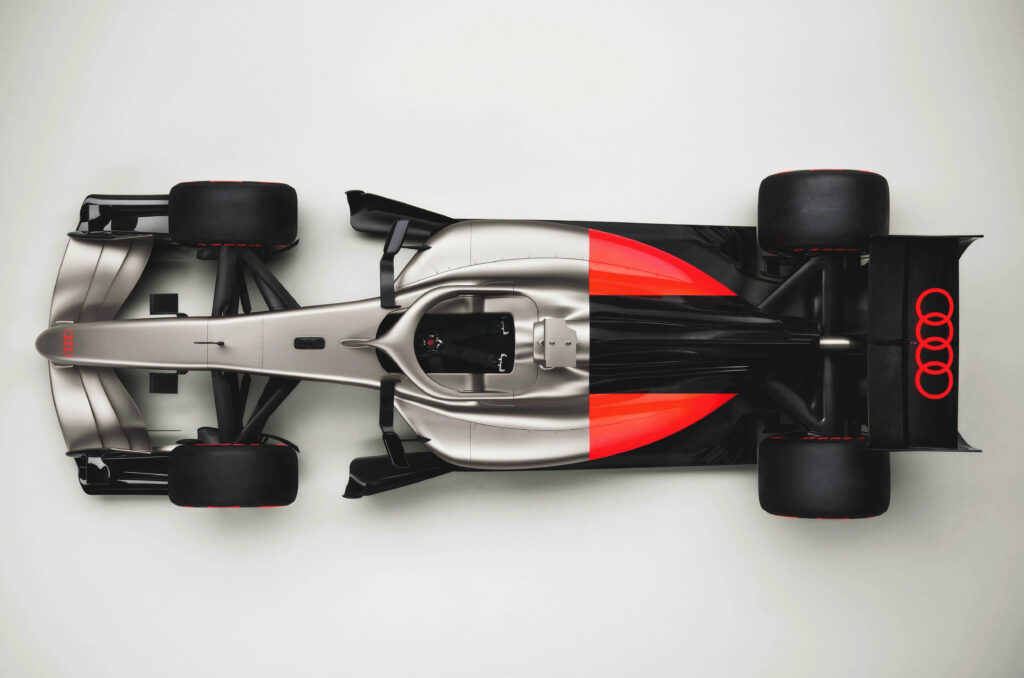
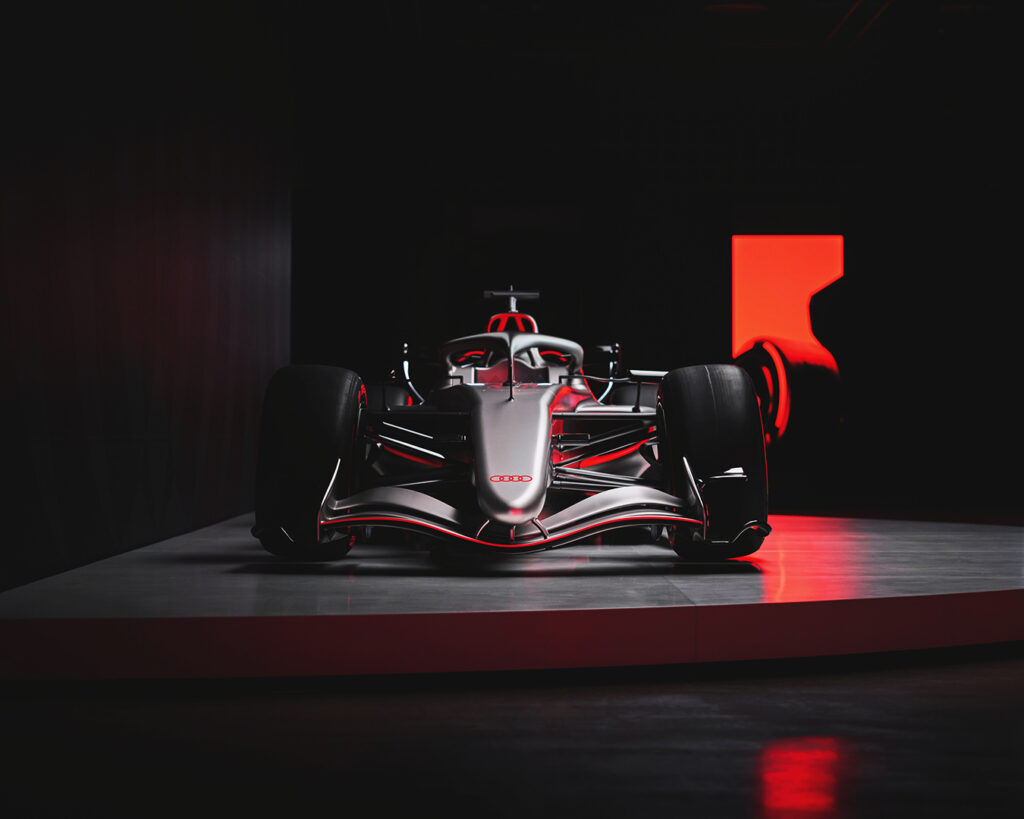
The Audi 2026 F1 show car, the R26 Concept, is incredibly striking and innovative in its simplicity. Titanium silver, carbon black and a new, neon-like Audi red form a chic, minimalist livery that draws inspiration from the Audi Concept C, revealed earlier last year. Carbon black – a dark raw carbon fibre – envelopes the car’s core, while titanium stretches from the engine cover forward, reflecting light with a silky, futuristic quality. Red accents outline the front wing, sidepod air intakes and the top intake above the driver’s head – and this is just a show car; we’re yet to see the full aero package.
“With our Formula 1 debut, we are introducing a unifying design system to bring together every aspect of our organisation. At its core are our four rings. They are the foundation upon which the rest of our brand is built,” says Massimo Frascella, Audi’s chief creative officer, who joined the company in 2024 from JLR, where he had led design since 2011, and the designer behind Audi’s new futuristic-leaning era. “This makes the Formula 1 project a pioneer for the new brand identity, which will be rolled out in the future both for the F1 team and Audi as a whole.” He adds: “The Audi R26 Concept is one of the first expressions of this new design system. We want to have the most striking car on the grid. We want to be the most daring brand off the track. And we want to create a cultural impact that goes beyond the grid.”
The cultural and commercial implications of Audi’s entry into Formula 1 are vast, especially for a company that, in recent years, has struggled with relevance. But all that is changing fast. With more than 820 million fans globally and 1.6 billion TV viewers in 2024, Formula 1 offers an unmatched platform to engage new audiences. “Formula 1 is more than just motorsport,” says Jürgen Rittersberger, Audi’s chief financial officer. “It’s entertainment, emotion, technology – and also a challenge. But it is precisely this combination that takes us where we want to go: inspiring new customer groups for Audi. With the enormous reach of Formula 1, we have the opportunity to attract new customers for our brand – especially in the younger target group, where Formula 1 is experiencing rapid growth.”
In a sport where every second counts, Audi’s debut will be measured down to the line, and not just on track, but in the way it reshapes the landscape of motorsport and its wider brand. The world will watch closely when the R26 finally roars to life on the track at the Melbourne Grand Prix this year, as the embodiment of a brand daring to merge heritage with technology, cultural relevance and a relentless drive towards the future. In the words of Döllner, Formula 1 is more than racing; it is “a catalyst for change towards a leaner, faster and more innovative Audi.” The race, as Audi sees it, has already begun.
Related:
Electric feel: Polestar’s first flagship GT arrives to shake up the high-end EV game