





Tennis supercoach Darren Cahill on coaching a killer instinct
Darren Cahill was a fine tennis player. But he’s an even better coach, one who’s guided four very different champions to the No. 1 ranking. Esquire went in search of his secrets
 By
By 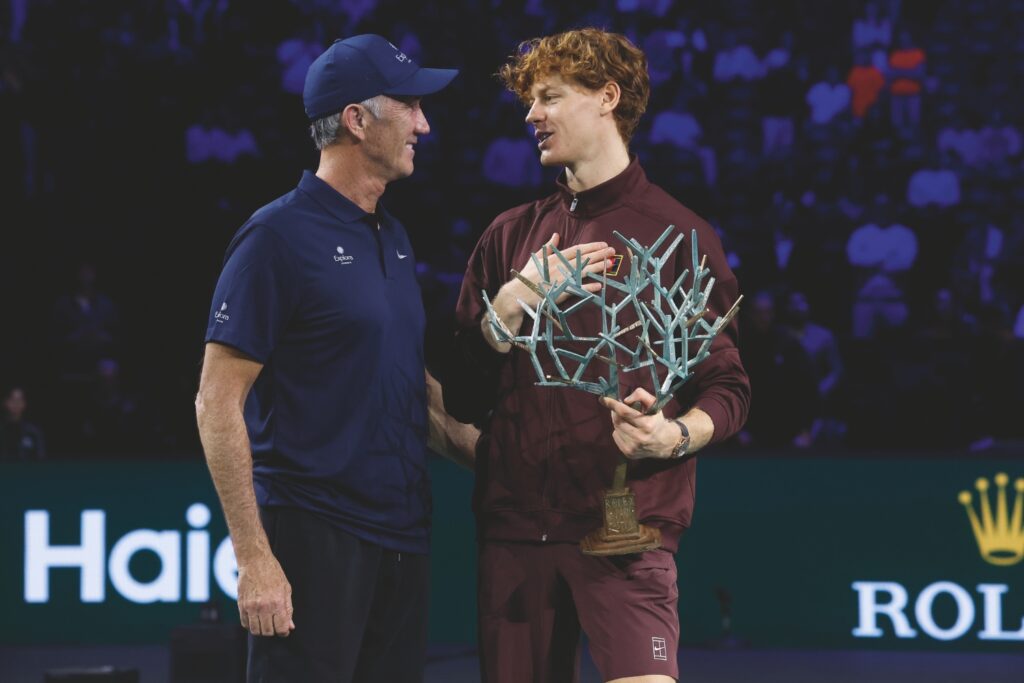
IT WAS WIMBLEDON, 2022, and Darren Cahill was grappling with the quarter-final loss just suffered by his 20-year-old charge, Jannik Sinner, who’d lost control of the match after being two sets up. What to do? Cahill took the unusual step of seeking out Sinner’s conqueror, Novak Djokovic.
“I saw Novak, and he’s always been incredible when you tap him on the shoulder,” Cahill told Andy Roddick’s podcast, Served. “I said, ‘Hey, listen, I just started with Jannik, don’t tell me anything you don’t want to tell me, but can I ask you what you were feeling out there?”
Djokovic told Cahill that while Sinner was a tremendous talent, his ball shape was flat and predictable, and his tactics limited. Consequently, the Serb had eventually settled into a rhythm and run away with the last three sets. “He went through his whole game and broke it down,” said Cahill.
Though comprehensive, Djokovic’s critique contained little to nothing Cahill didn’t know already. But that wasn’t the point. “Because when you take that conversation and sit down with a young man like Jannik Sinner, and you say, ‘Hey, I just spoke to Novak, and this is what he thinks . . . that leaves a big impression on a young player. So, for Jannik, it’s, ‘Right, let’s start making these changes!’” In the middle of 2022, Sinner was on the cusp of the top 10. At time of writing, with Carlos Alcaraz, he is one half of a duopoly that could dominate men’s tennis for many years to come.
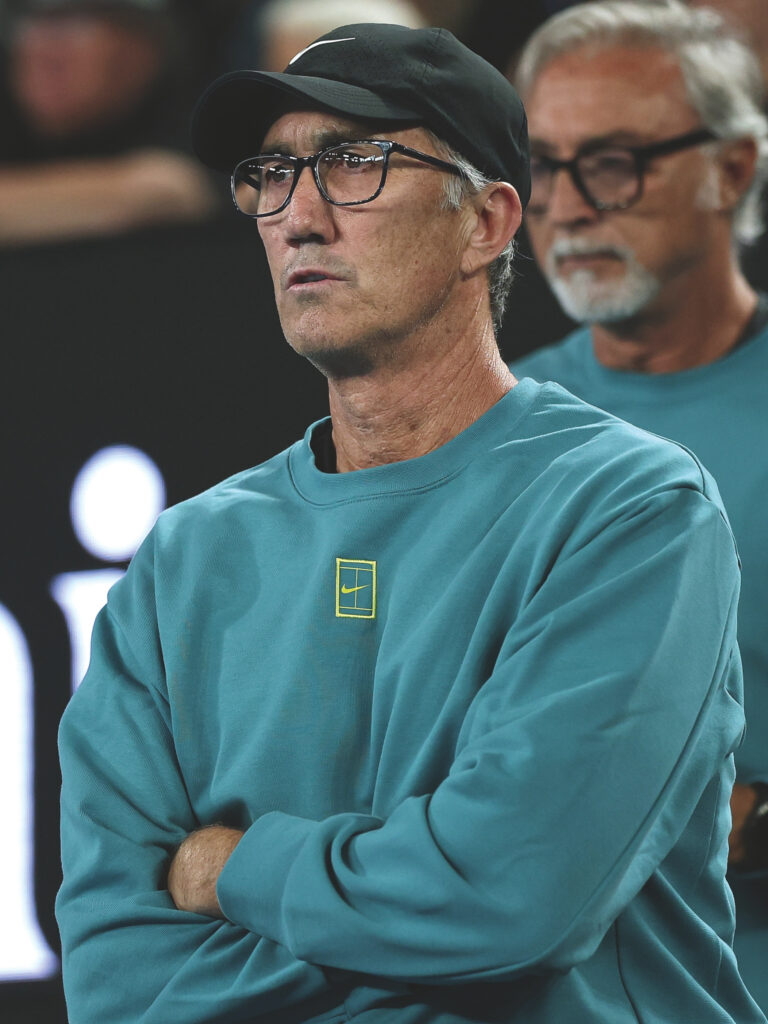
While Australia has not had a men’s champion at any grand slam since 2002, in Darren Cahill, it has someone who’s making a strong bid to be considered as one of the country’s greatest-ever coaches. In well over two decades at the top, Cahill has coached Lleyton Hewitt, Andre Agassi, Simona Halep and, most recently, Sinner, all to the world No. 1 ranking and grand slam titles – seven, to be exact. Cahill might be far too modest to admit it, but he ranks alongside other bona fide Australian greats like Harry Hopman, who led Australia to 22 Davis Cup titles, and Tony Roche, who followed up a stellar playing career by coaching Ivan Lendl, Rafter and Roger Federer to majors victories.
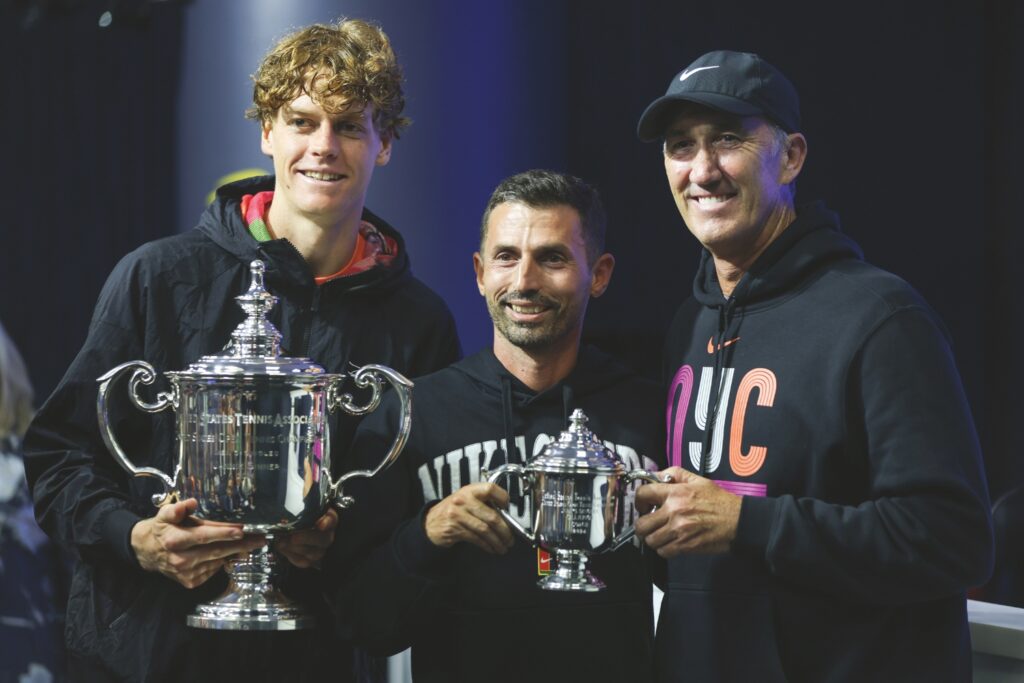
Cahill joined Sinner’s coaching team in the Northern summer of 2022, when the Italian was looking for someone to take him to the next level. Working diligently and smartly alongside Simone Vagnozzi, Cahill helped remould the Italian’s serve and, in addition to helping him to reach world No. 1, he navigated him through difficult situations, none more than when Sinner failed two drug tests in March 2024, testing positive for Clostebol, a banned anabolic steroid. The Italian was cleared of any intent to cheat but later served a three-month ban, nonetheless.
“He [Cahill] has been an amazing person and, obviously, coach for me, to hold the whole team together in the tough moments,” Sinner said last year. “He is like a second father to me.”
Nicknamed ‘Killer’ since his junior playing days for his ability to beat bigger, older opponents, Cahill was a fine player in his own right, serving and volleying his way to the semi-finals of the US Open in 1988, having beaten Boris Becker in the third round, and reaching a career-high ranking of 22 in singles, winning two titles. He was even more successful in doubles, winning 13 titles and reaching a ranking of No. 10. But for injuries, he would surely have gone higher. “I was a poor man’s Pat Rafter,” he told Caroline Garcia’s podcast, Tennis Insider Club, with typical self-deprecation, last year.
If ever someone was born to be a top coach, it is Cahill. Raised in Adelaide, Cahill grew up in the immense shadow of his father, John Cahill, the legendary SANFL coach, who led Port Adelaide to 10 premiership crowns across three decades. Watching the way his father worked, seeing how he treated people and noting his attention to detail helped to shape Cahill’s own philosophy of coaching.
“I think as I’ve grown older you come to realise what impact his playing career and, more pointedly, his coaching, had on you – the way it shaped my own career,” Cahill tells Esquire. “I would say that he was ahead of his time as a coach because a lot the qualities he possessed and used 50 years ago, we are preaching now as the way to evolve as coaches and connect better to our athletes. Setting principles and addressing culture within a team, while never coaching two players the same way. Connecting to the emotional side of the athlete and understanding them better.”
Cahill explains that technical expertise is just one component of coaching, and probably not the most important. His father, he says, “spent an enormous amount of time getting to know his players and working out how best to coach them to improve. The one [observation] that all his former players made is that Cahill saw the greatness that lay within each player, whatever that may have been. He coached them to believe in themselves to the point where nothing was impossible.”
It’s fun to think of Cahill sitting alongside his old mate, the late Peter Carter, chewing the fat while their teenage charges went about their business. Cahill had a young Hewitt while Carter had Roger Federer, and even when the two future champions played each other in big junior matches, Cahill and Carter would sit together, chatting away, even as their players behaved badly, as was often the case.
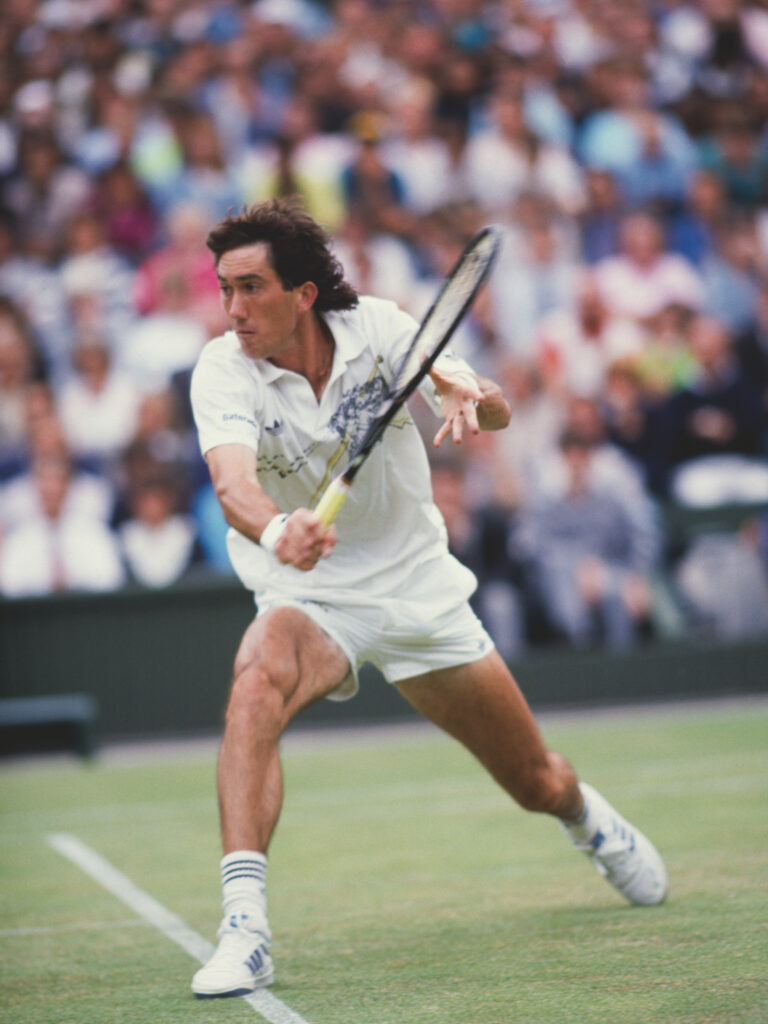
Cahill likes to say he’s been lucky, pointing to his start in coaching, when a 12-year-old Hewitt knocked on his door and asked him to hit with him, saving him, he says, at a time when he had invested in a local bar and was unsure what to do next. After cutting his teeth with Hewitt, who won the US Open in 2001, Cahill received a call from Andre Agassi, who had parted ways with Brad Gilbert and was looking for someone to inspire him in his final few years on tour. Cahill had been set to coach Marat Safin, the Russian, but when Agassi called a second time, he agreed to link with the enigmatic American. Working with such a legend could have been daunting. But Cahill eased his way in, listening, learning how Agassi’s mind worked.
“The first six weeks I worked with Andre . . . I didn’t tell him anything, basically I just asked him questions, got to know him. I tried to get a feel for how he saw the game,” Cahill told Tennis Insider Club. “If you’re a consultant coach, coming in for a week here and there, I struggle with that because players need time to be able to take your information, go away and work on it. They’re never going to believe it until they feel it. Sometimes, feeling something on a tennis court can take days or weeks.”
Later, after a long spell as part of the Adidas Player Development Program, Cahill joined forces with the Romanian Halep in 2016 – and again took his time. “He didn’t come in and say, ‘I’m the boss, do it my way’,” Halep tells Esquire. “He asked questions, he made me think, he made me grow personally, and that unlocked the next level for me . . . that moment when you shift from being just good to believing you can win the biggest tournaments. I believe Darren helped me make that shift.”
Halep stressed how Cahill “always found the right balance between support and honesty”, and said he “understands people deeply, not just players”. Halep lost her first three slam finals, including in Melbourne in 2018, but bounced back to win the French Open later the same year, a triumph masterminded by Cahill. “He had this calm energy that made everything seem possible again,” she says.
Back in the day, Cahill won seven doubles titles with Mark Kratzmann, a former junior world. No 1 who won three of the four junior slams in 1984 and lost in the final of the other. The pair were both coached by Bob ‘Nails’ Carmichael at the Australian Institute of Sport and remain good friends. Kratzmann saw early on that Cahill had the skills required to be a top coach.
“He’s very, very analytical and also very calm,” Kratzmann tells Esquire. “He can see past the angst of bad losses to going, ‘We are making a one per cent improvement today and being happy with that’. I don’t know if that is from his father, or if that was in him. He plays the long game very well with players. His skill is in the analytical stuff, but also in the way he manages the personalities. He’s coached Hewitt, Agassi, Sinner, Halep . . . how did he get the best out of all of them? This is what I don’t understand. My personality would mesh with somebody and it’d be fun. But then with others, you’ve kind of got to make it work. You put those four personalities together – they’re very different people.”
Equally adept as an analyst on ESPN, Cahill says he would never work with someone he didn’t like as a person. Hugely popular with players, fellow coaches and media, he is always happy to give his time and offer advice. It was Cahill who suggested Andy Murray hire Ivan Lendl as his coach – the Scot then finally broke his grand slam duck after losing his first four finals. And it was Cahill who told Sinner that teenage Brazilian star Joao Fonseca was considering going to university, prompting the Italian to tell him that he was too good at tennis to do that.
“If he’s not liked by someone, they’re ignorant of who he is, I would say,” says former Australian player John Fitzgerald. “He doesn’t need to coach for the sake of getting another good player. He’s not the guy who just needs to get a great player for the sake of it. He is the guy who wants the good person, which I just love about him, because I think that says a lot about an individual. And there’s not enough of that in our world at the moment. Not [just] in the world of sport, but particularly in a broader sense, I think.”
Cahill believes there is an optimum duration for a coach-player relationship, feeling that after a certain point, the player has learned everything the coach can give. Having told Sinner that 2025 would be their last season together, the Italian has been trying everything he can to convince Cahill to stay on.
Should Killer Cahill take on another player sometime in the future, there is little doubt he will choose wisely and make a big impact again. Whatever he decides, his place in history is assured.
Related: