





Retail therapy: how wellness became the new frontier of bricks-and-mortar shopping
Feel good? Spend more!
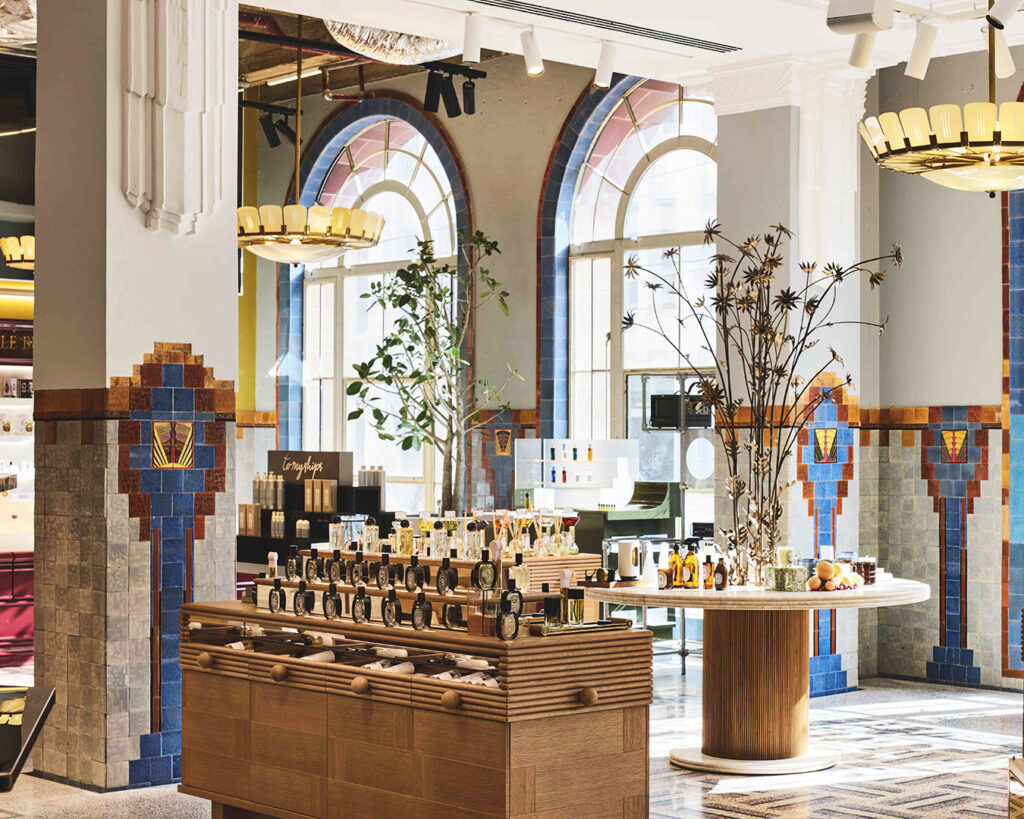
MELBOURNE’S BOURKE STREET MALL has always traded in spectacle. Once the stage for Cole’s Book Arcade, later for the department-store machismo of David Jones, now it’s Mecca’s turn. The Australian beauty giant has cracked open the old shell and remade it into something stranger: a wellness palace disguised as a shop.
The heritage-listed building – faience tiles, arched windows, terrazzo ghosts under layers of linoleum – has been peeled back to its bones. This aesthetic excavation was conducted by Surry Hills-based Studio McQualter, long-time collaborators with Mecca founder Jo Horgan, who rebuilt it with a certain reverence, but also a wink. “The brief was to create the world’s most extraordinary, innovative and loved experiential beauty destination,” they say. Which is another way of admitting that retail at this scale isn’t about shelves and sales. It’s theatre.
And like all good theatre, it needs an atmosphere. “With wellness now embedded as a core part of Mecca’s brand, we wanted the architectural language and material palette to reflect a sense of calm, balance and rejuvenation,” the studio explains. Calmness in a 4000-square metre, three-level flagship fusing multisensory stimulation is a paradox, but paradox is part of the performance.

The restoration itself reads like an archaeological dig. Aztec-patterned tiles reappeared from beneath decades of flooring. Decorative plaster ceilings were unboxed. The removal of an awning revealed five monumental arches along Bourke Street Mall. “Five arches and five letters for Mecca,” as Horgan has described it.
Heritage is one thing; how you animate it is another. The McQualter team talk about “peeling back the layers that had long obscured the site’s architectural heritage”. The result is a façade that marries old Sunshine, Victoria-made faience tiles with new recast terracotta from the UK. The verticality of the building has been reasserted. And inside, raw concrete columns stand beside polished marble, heritage terrazzo beside 20 new bespoke tile combinations.
It is a palimpsest of Melbourne retail history and Mecca’s own ambitions.
In beauty retail, wellness is the new luxury. It’s not enough to simply stock the product that promises transformation; the architecture itself needs to be transformative. “The use of light and materiality was carefully considered to encourage moments of pause and connection, aligning the physical environment with Mecca’s wellness ethos while still delivering the energy and playful spirit that defines the brand,” Studio McQualter says.
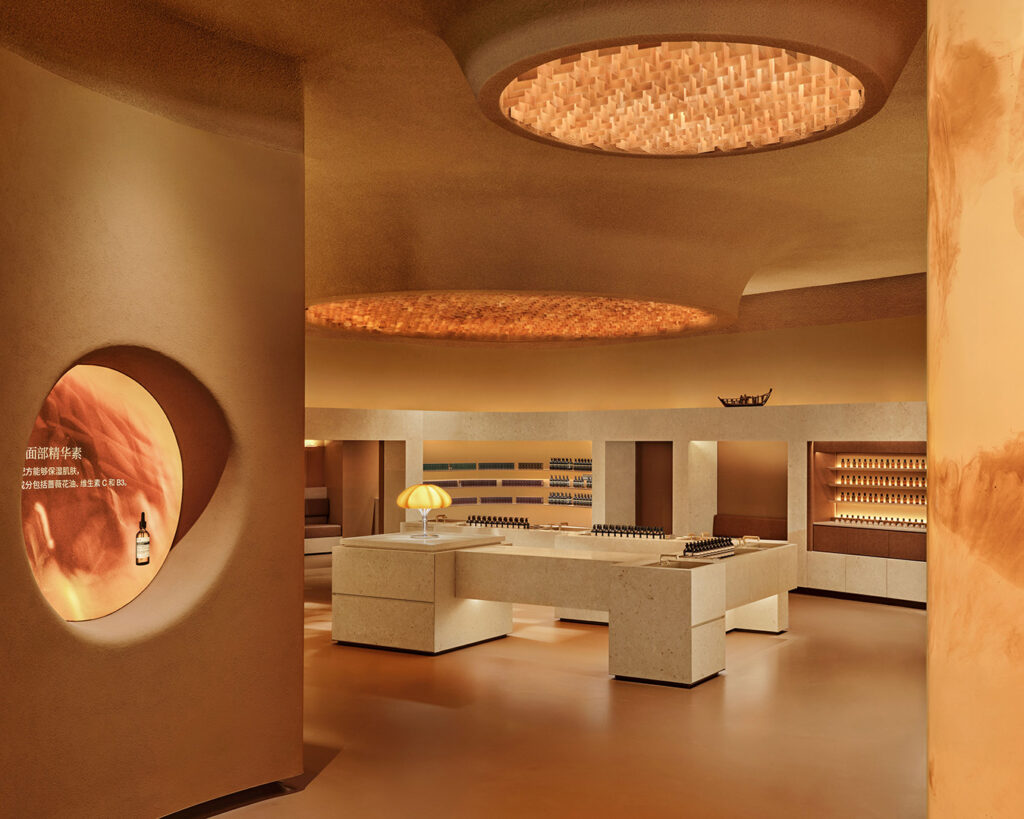
That duality plays out in the details. Trees – four banyan and two Moreton Bay figs – are planted inside the Apothecary and Perfumeria. Upstairs, the Aesthetica Lounge is furnished with rugs, custom seating and works by artists Julie Rrap, Nabilah Nordin and Judy Watson. “We hope visitors feel inspired, curious and welcomed,” the designers say.
Even the escalators were relocated to create voids, opening new sightlines to heritage ceilings. “The newly opened voids created the mezzanine and relocating the escalators allowed us to open the space further, visually and physically connecting these spaces so that new sightlines and the decorative heritage ceiling can be seen,” they note. The idea is less about efficiency, more about a kind of urban dérive indoors.
Wellness as architecture didn’t start here. To be fair, Australian skincare brand Aesop has been playing this game for decades. In China’s Hainan, a relatively recent store opening resembles an underwater cave, complete with columns wrapped in sustainable, algae-grown polymers that can absorb and release ambient, calming aromas (supplied by Melbourne-based materials lab Other Matter) and ceiling oculi that flicker like ocean light. In São Paulo, Paulo Mendes da Rocha’s team turned civil construction materials of concrete, glass and patterned cement tiles into an elegant apothecary.
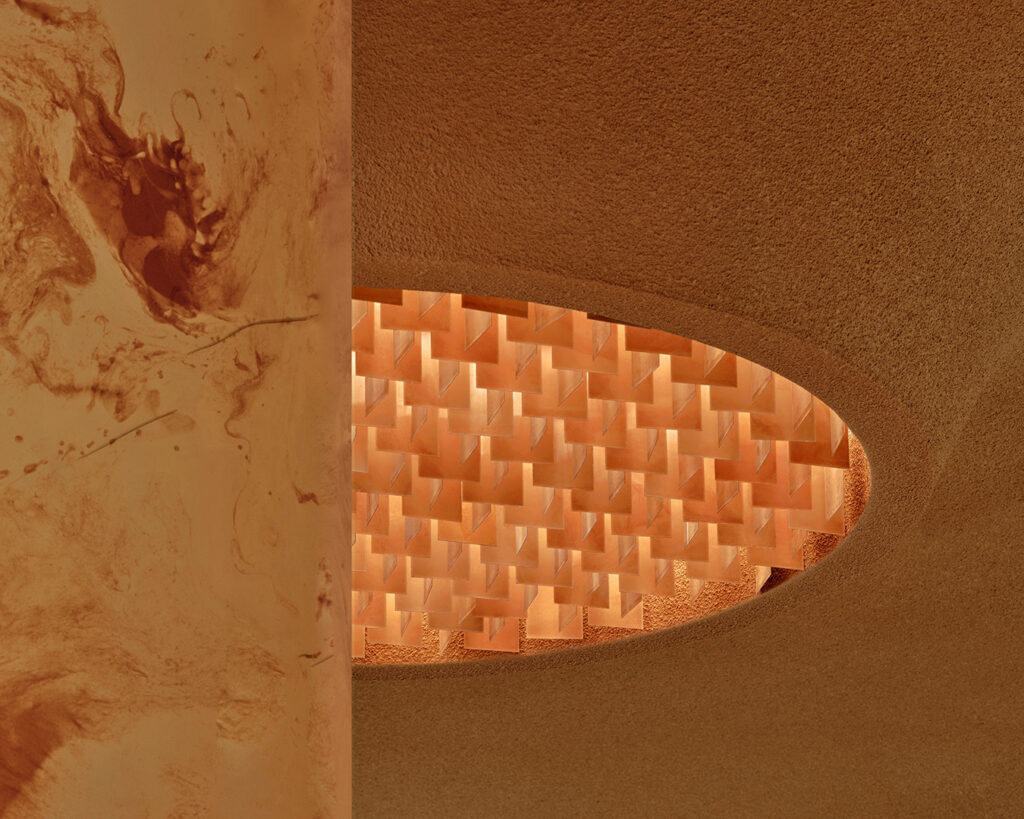
Each Aesop outpost is both hyper-local and globally legible. A column clad in algae, a floor of cobogó brick, a cascade of water into tin basins: ritual, not retail. As Marianne Lardilleux, the brand’s global retail design director, has said about their concepts: “Our goal is not just to create beautiful visuals, but to focus on the overall experience of the space”.
Mecca borrows that playbook, but amplifies it. Aesop’s stores feel like chapels; Mecca’s flagship is a cathedral.
Before beauty became the frontier for retail’s evolution, it was back in 2001 that Prada disrupted the entire system with their legendary Prada Epicentre in New York. Designed by Rem Koolhaas, it was less a store than an architectural provocation. Its famous “Wave” ramp doubled as seating, podium and sculpture, while clothes were pushed to the periphery. Koolhaas called it an antidote to “Flagship syndrome – a megalomaniac accumulation of the obvious”.
Prada’s gambit was to strip luxury shopping of certainty. The space was deliberately unstable, its excess of emptiness the true indulgence. At the time, Koolhaas was quoted as saying: “I tried to inject instability to make a radical space. You never know what you are going to get here”.
That logic – that architecture itself is the product – still reverberates. Mecca doesn’t go as far, but its Bourke Street flagship is clearly heir to Prada’s suspicion that retail should feel less like shopping, more like cultural immersion.
Art saturates the flagship. Diena Georgetti’s mosaic panels frame columns. Bethan Laura Wood’s chandelier glitters in the Perfumeria. Patricia Piccinini’s absurd pink wig sculpture dangles above a stairwell. Upstairs, large prints by Rrap and sculptures by Nordin sit beside the skincare shelves.
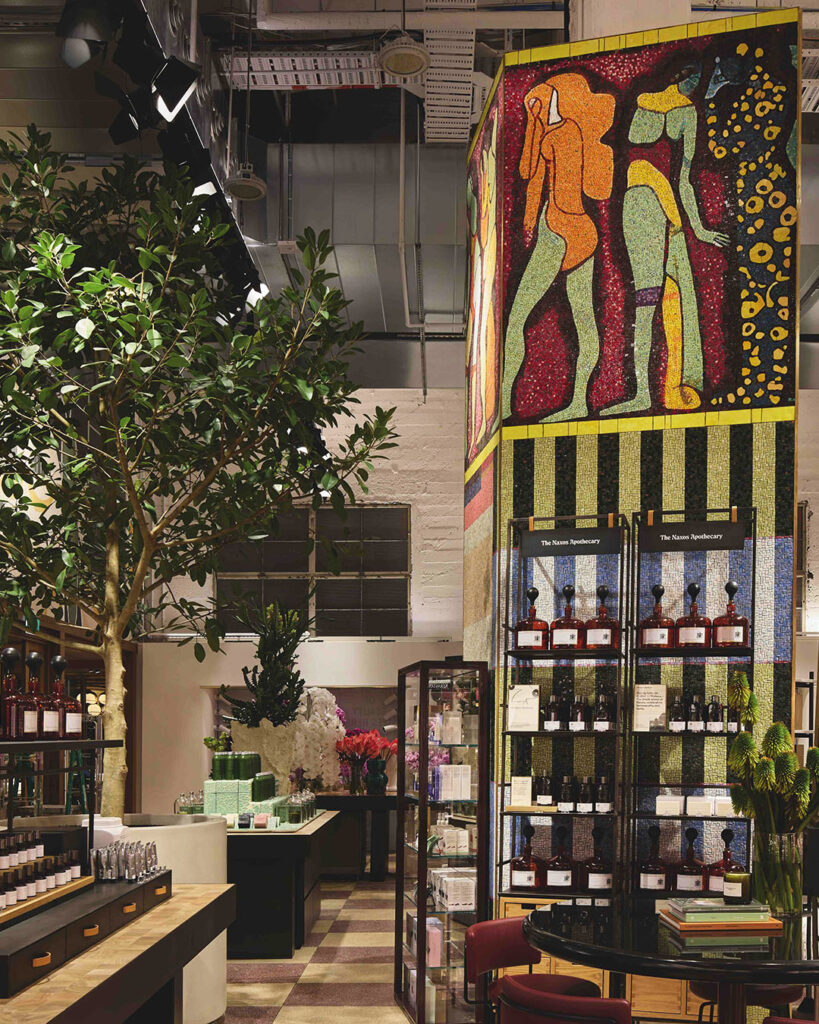
You could argue that the use of art within the space goes beyond decorative flourishes into declarations of aesthetic politics. As Charlotte Day, curator of the Mecca Collection, has observed: “It’s hard to pinpoint what bringing art in does, but I know it does change the feel of a space significantly”.
Retail becomes exhibition, wellness becomes aestheticised. And in that shift, the boundaries between beauty and culture blur.
So, what does luxury mean in this context? Studio McQualter answers plainly: “We wanted to craft a space that embodies Mecca’s playful and luxurious spirit. We blended vibrant, artistic elements with a sense of generosity and openness.”
Here, luxury is not scarcity but abundance. Of light, space, sightlines. The ability to wander, to pause at the marble bar, to sit in the Aesthetica Lounge without buying a thing. Prada framed emptiness as luxury. Mecca reframes it as generosity.
Despite the spectacle, there are recesses of quiet. “Upstairs, the Aesthetica Lounge and Atelier add a luxurious layer to the customer journey,” McQualter notes. A bar pays homage to Melbourne’s dining culture, with marble counters and leather banquettes. The mezzanine floats, lined in recycled American white oak.
These pauses are essential. Without them, the flagship would collapse into chaos. With them, it becomes rhythm, crescendos of art and marble balanced by moments of calm.
In the end, the Bourke Street flagship is a kind of paradox. It is a shop, yes, but one that wants to be more: part gallery, part bathhouse, part cultural forum. Like Aesop’s chapels and Prada’s Epicenters, it insists that design itself is the wellness product.
“Across all our collaborations with Mecca, the consistent ‘DNA’ has been a focus on creating immersive, sensory experiences that feel both luxurious and welcoming. Each store celebrates the brand’s bold personality through a strong sense of materiality, meticulous detailing and an intuitive flow that invites playful exploration,” Studio McQualter says. “With Bourke Street, we wanted to honour that foundation. The scale of the space, combined with its heritage context, gave us the opportunity to experiment. It’s unmistakably Mecca, but with a new level of elegance.”
German philosopher Walter Benjamin once wrote that the 19th-century department store was “the last promenade for the flâneur”. Today, online shopping has taken over the transactions. What remains for physical stores is the promenade itself. The act of wandering, looking, pausing. Mecca’s flagship is built for that. Complete with Lune croissants and coffee to sustain you on your journey. It is architecture as promenade, theatre as wellness, commerce as culture and the possibility that a store can make you feel well simply by being inside it.
Related:
How industrial designer Henry Wilson found his missing piece